

A draft email and a refund instruction may sound equally routine to an assistant. They do not deserve the same access or review.
When people start using AI at work, many split tasks by feel: small jobs go to the assistant, big ones stay with them. It sounds sensible and often goes wrong, because “small” and “big” miss the question that matters: if the result is wrong, who notices, when, and can it be undone? This piece offers a different split, based on consequence, evidence and reversibility, not on how confident the answer sounds.
Start with four ordinary tasks
Take four familiar office tasks and ask, for each one, what the AI can contribute and what a person still answers for.
| Task | AI contribution | What stays accountable |
|---|---|---|
| Summarise an internal document | A draft with source handles | Permission to send the input; verification of material claims |
| Draft a customer email | Proposed wording | Facts, commitments, recipient and authority to send |
| Suggest a code change | A reviewable implementation | Acceptance, appropriate checks and release authority |
| Issue a refund | Evidence gathering or a bounded proposal | Identity, policy, approval and enforced write permissions |
A summary is not automatically low risk: it may contain private data or guide an expensive decision. An email is not automatically high risk: a reviewed internal draft can be harmless. Judge the actual material and destination.
Look at the right-hand column. In all four tasks, what the person keeps is not the hard-to-write part but the part tied to authority: permission to share data, to promise a customer, to release, to spend. The AI can do a lot of the work. The authority stays with whoever is accountable.
Four levels of delegation, not two
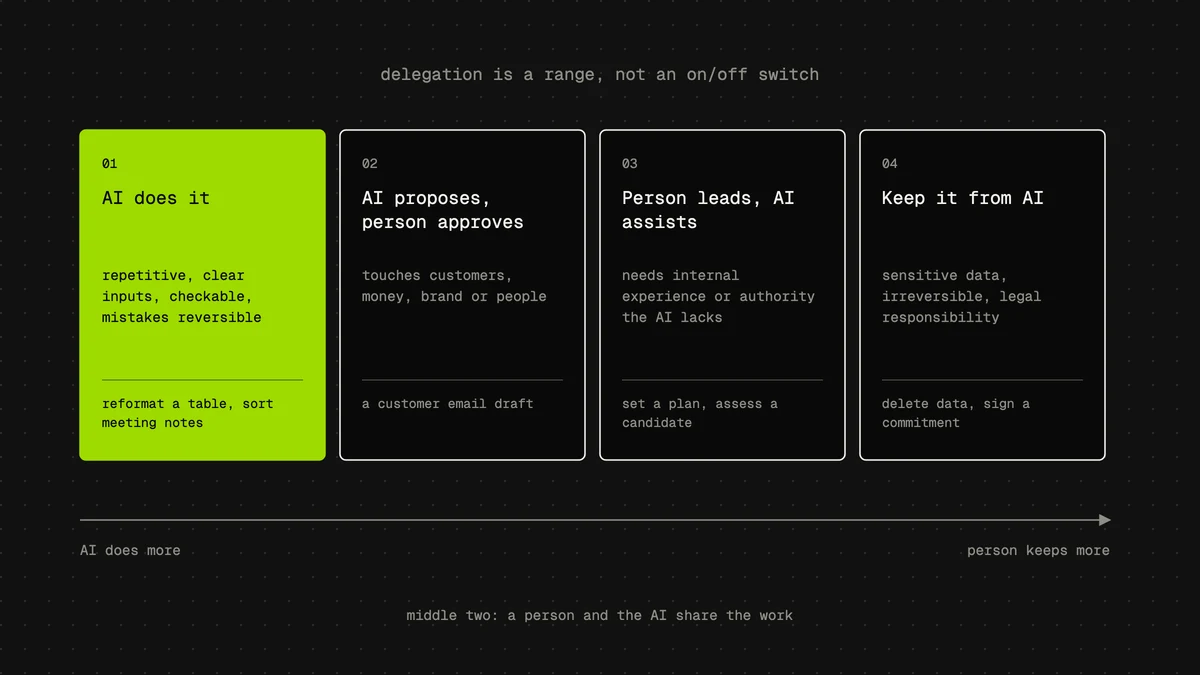
“Give it to the AI” versus “do it myself” is too coarse. In practice there are at least four levels, and the middle two are where a person and the AI share the work.
- AI does it. Repetitive work with clear inputs, checkable output and reversible mistakes, such as reformatting a table or turning meeting notes into an action list. A person still spot-checks, but does not approve every run.
- AI proposes, a person approves. Work that touches customers, money, brand or people. The AI drafts; a person reads and decides whether to use it.
- A person leads, AI assists. Work that needs internal experience or authority the AI does not have. The AI helps look things up, suggests angles and checks for errors; the person drives.
- Keep it away from AI. Work involving sensitive data, irreversible actions or legal responsibility. Do not give the AI that data, and do not give it the power to act.
Make review effort match consequence
Before deciding how closely to review, answer three questions:
- If the result is wrong, how easy is the error to detect?
- How costly is it, and who pays?
- Can the action be reversed?
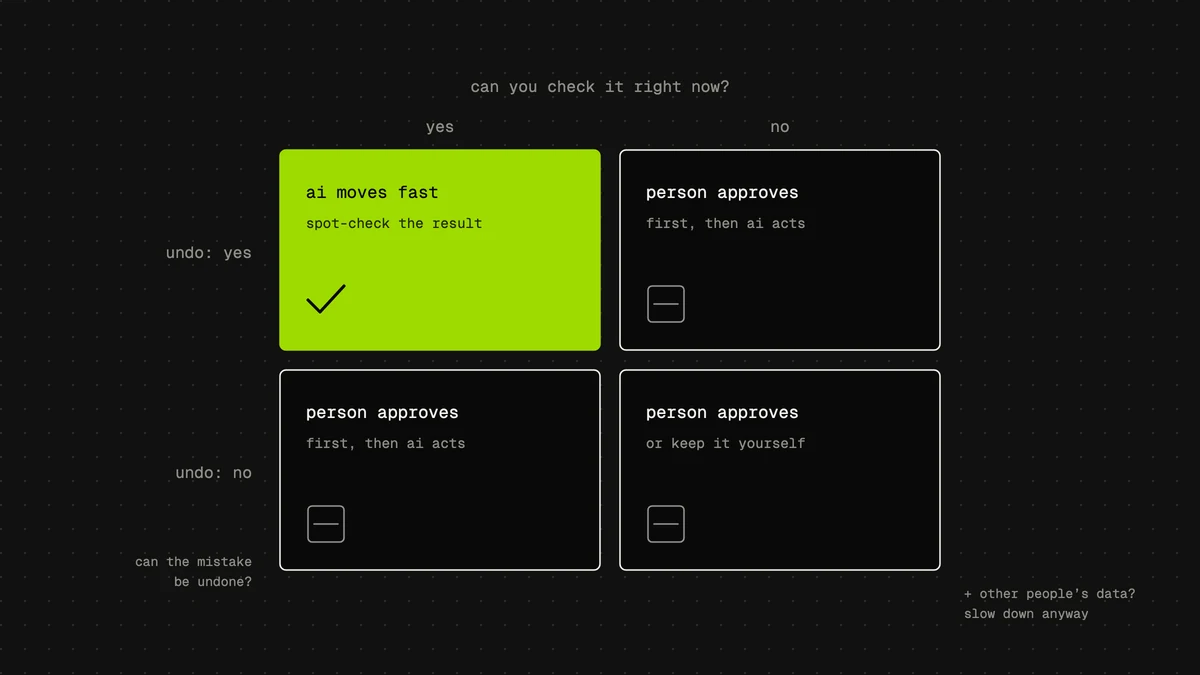
A formatting mistake and an unauthorised payment need different safeguards. A reversible interface action can still have privacy consequences.
The person responsible needs evidence, not merely a model’s assurance. Another model’s agreement may help find inconsistencies, but it does not independently establish the customer identity or policy.
So “the AI sounds sure” is not evidence. Evidence is something the reviewer can open and see: the source record, the current policy text, a test run, the order history.
A worked example: a customer asking for a refund
Take a common customer-care case: a customer writes that an order arrived late and asks whether they can get a refund.
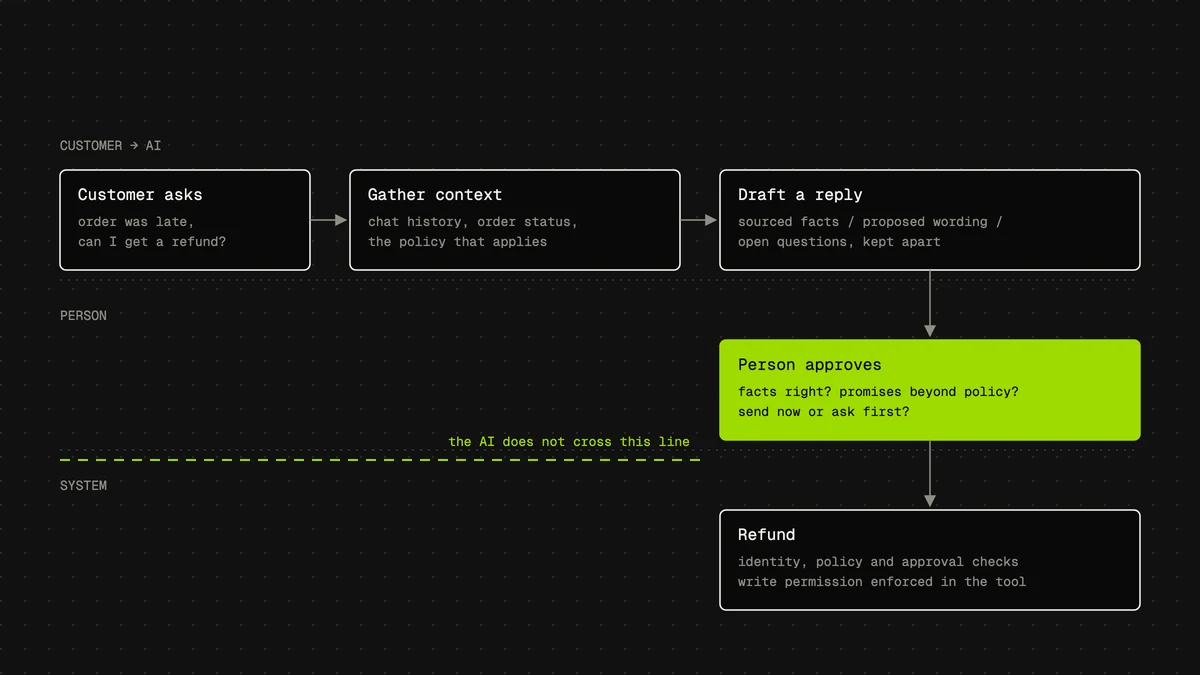
The AI is good at gathering context: summarising the conversation, pulling the order status, finding the refund policy that applies and drafting a polite reply. The draft should separate sourced facts from proposed wording, and list any question it could not answer.
The person keeps three decisions: are the facts in the draft right according to the system, does the reply promise anything beyond policy, and should it go now or does it need a follow-up question. “We will refund you today” sounds friendly, but it is a commitment, and the AI has no authority to make it.
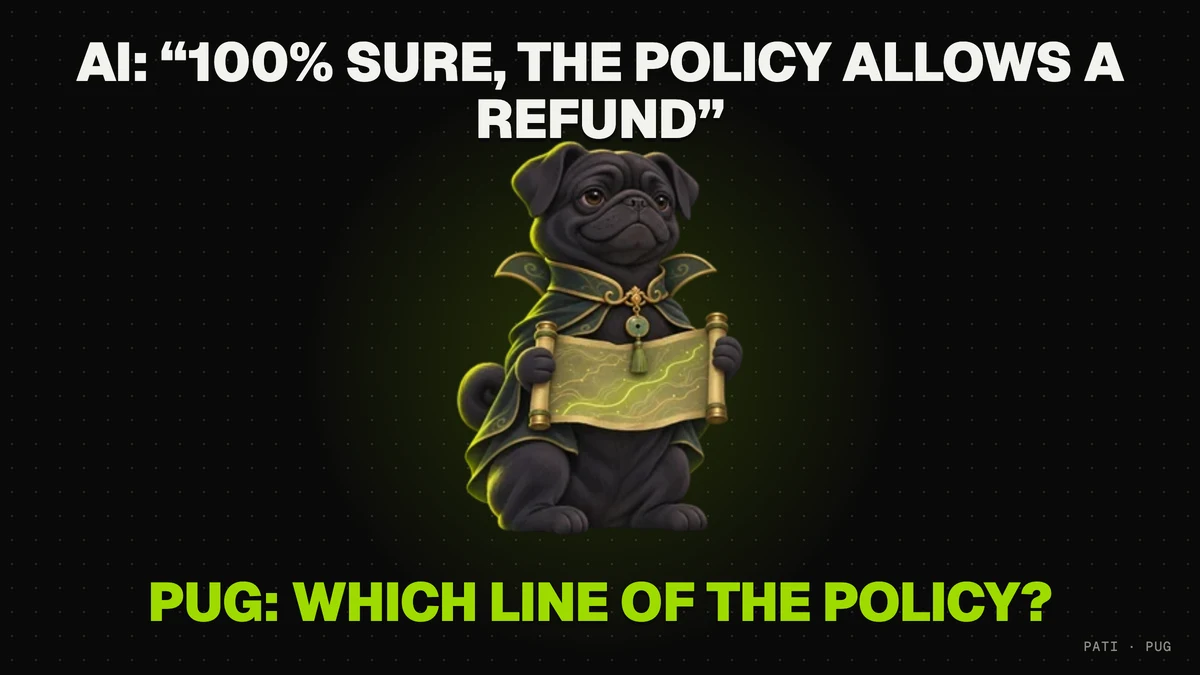
The refund itself is not part of the draft. It goes through a system with its own identity checks, policy checks and approval. If a process ever lets an AI reach that step, the limit must be enforced in the tool’s permissions, not only written in a prompt.
Write the boundary into the brief and the tools
Give the assistant a goal, permitted inputs, output shape, evidence requirements and stop conditions. Improve the brief when a draft misses its purpose, rather than just asking for another try.
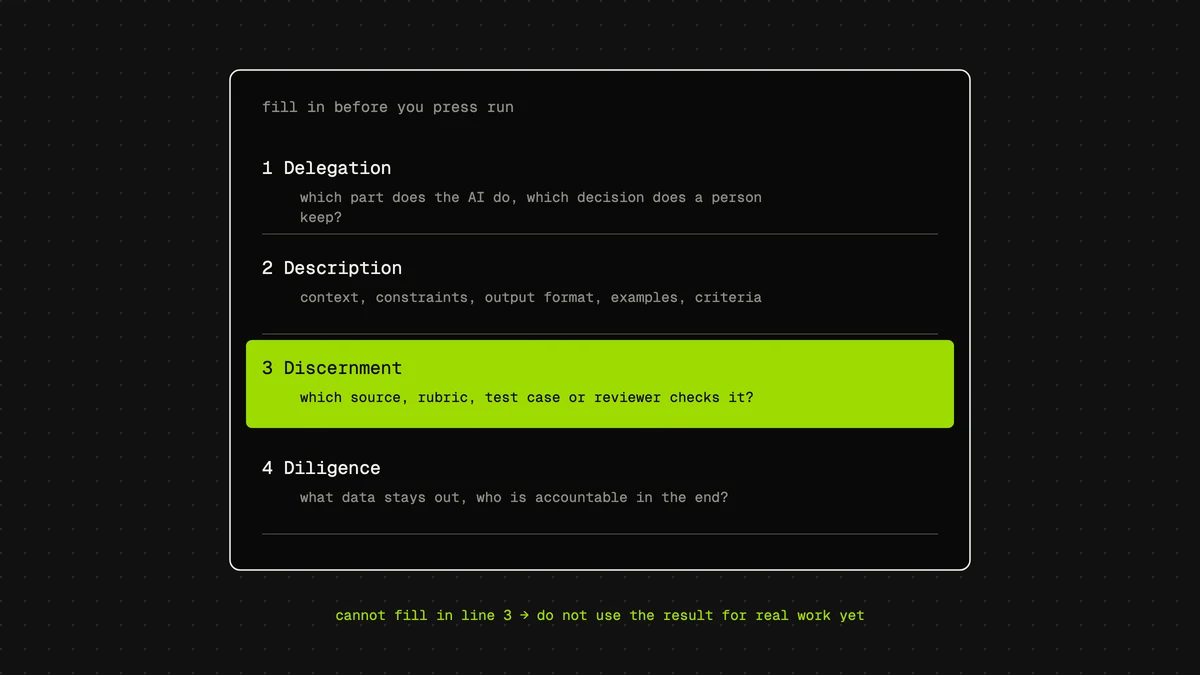
A simple way to do this every time is a four-line card, filled in before you press run. It follows the 4D framework from Anthropic’s AI Fluency course:
- Delegation: which part does the AI do, and which decision does a person keep?
- Description: what context, constraints, output format, examples and criteria does it need?
- Discernment: what source, rubric, test case or reviewer will check the result?
- Diligence: what data must stay out, and who is accountable in the end?
If you cannot fill in the Discernment line, do not use the AI’s result for real work yet.
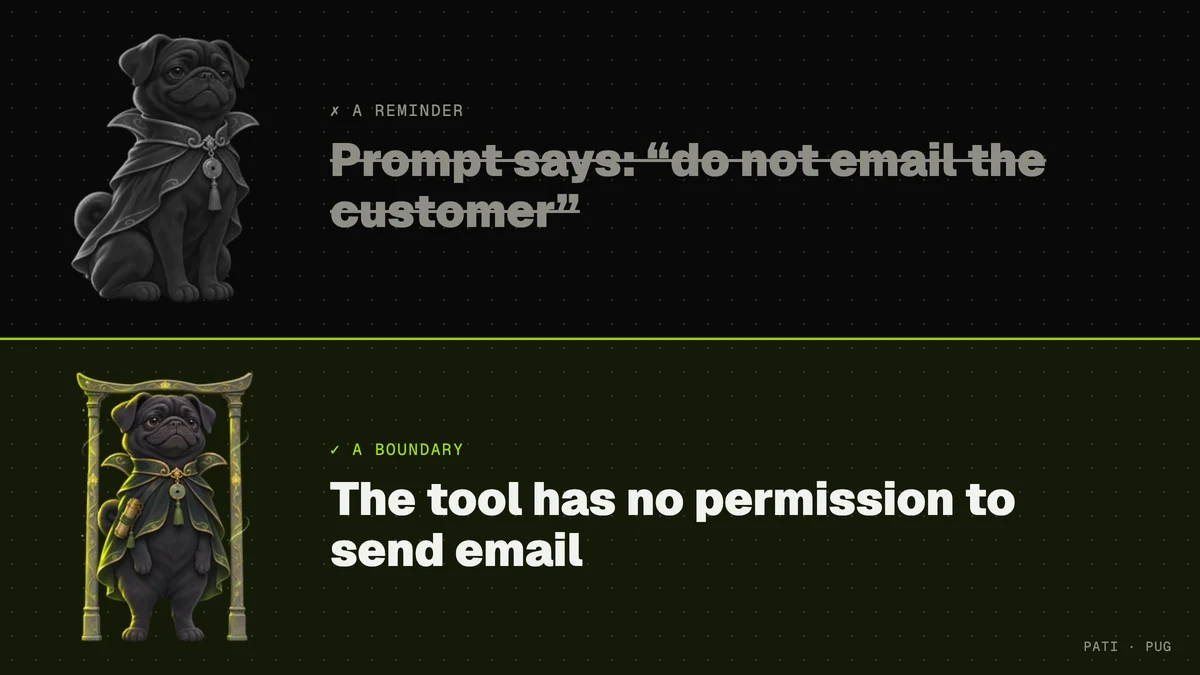
Check the data boundary before sending material. For consequential actions, enforce permissions at execution, not only in prose.
“Do not email the customer” in a prompt is a reminder; a tool with no permission to send email is a boundary.
Three common mistakes
- Letting the AI decide for the accountable person. The AI proposes; a person decides. If nobody can say “I approved this”, the decision has no owner.
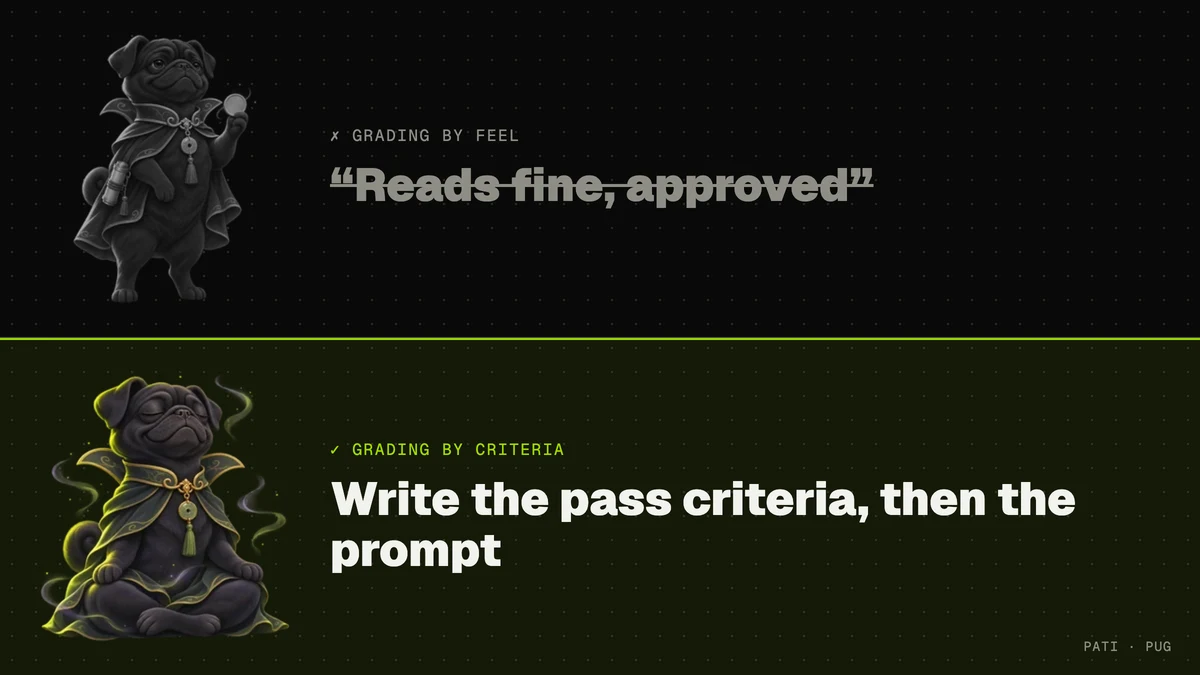
- Grading by feel. Reading the output and thinking “looks fine” checks the tone, not the content. Write the pass criteria before writing the prompt.
- Pasting everything in. API keys, customer data and sensitive internal documents are rarely needed for the task at hand.
Where the judgement stays
Keep the final judgement where responsibility belongs. The useful delegation is one that removes work while leaving the decision understandable and controlled.

The question to bring each time is not “can the AI do this?”, because the answer is usually yes. It is: “if the result is wrong, will I know, and can I fix it?” Answer that, and you will know how much to hand over and how much to keep.
Sources
- Rick Dakan and Joseph Feller with Anthropic, AI Fluency: Framework & Foundations, the course that defines the 4D framework (Delegation, Description, Discernment, Diligence).
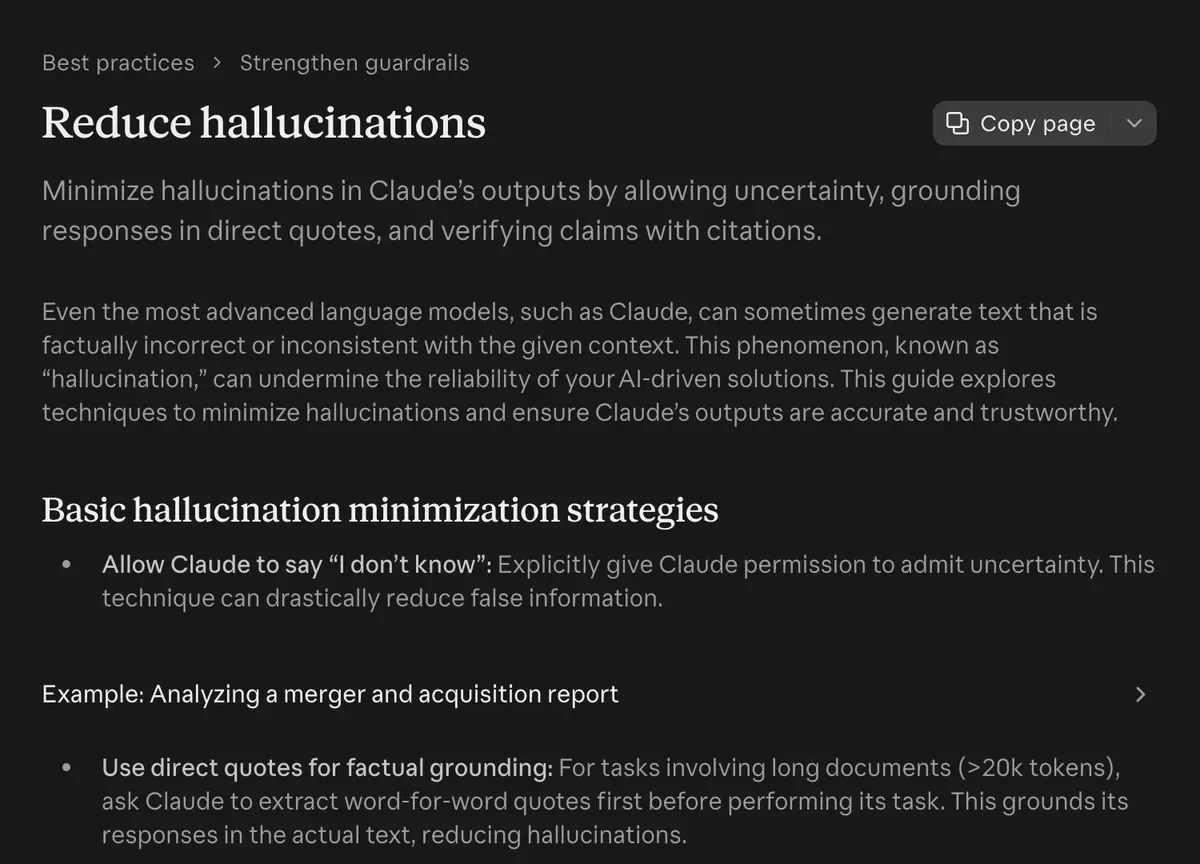
- Anthropic documentation, Reduce hallucinations.
- The four delegation levels, the four-line card and the three common mistakes come from PATI AI Academy’s internal notes on the 4D framework, based on the course above.
- The four error spectra, the delegation buckets and the checking levels are from the author’s study notes and are rules of thumb, not measured results.
- Images: screenshots of anthropic.com and docs.claude.com (the cited pages). Diagrams, memes and the pug illustration by PATI.
- A shorter first version was published at raymondnguyen177.vercel.app.